


How intelligent automation transforms everyday operations for New Zealand businesses
The Operations Efficiency Imperative
In conversations with businesses across New Zealand, a consistent theme emerges: operational efficiency directly determines competitiveness.
When your competitor can quote faster, price more accurately, manage inventory more efficiently, and bill more reliably—they win business. When manual processes consume capacity that should be devoted to growth initiatives, your expansion plans stall.
The NetSuite 2026.1 release introduces AI-powered operational capabilities that address precisely these challenges: intelligent pricing optimisation, vendor consignment management, extensive warehouse and shipping enhancements, and flexible subscription billing.
NetSuite Advanced Pricing: Rules-Based Intelligence Meets AI Insights
Pricing represents one of the most critical operational challenges. The competing pressures are familiar:
"Price too high, lose the sale. Price too low, sacrifice margin. Get it wrong consistently, damage profitability."
For businesses managing thousands of SKUs across multiple customer segments, pricing optimisation requires sophisticated tools—not spreadsheet maintenance.
The Pricing Management Challenge
You stock thousands of SKUs across multiple product categories. Your customers span different segments—large accounts, small customers, trade buyers—each requiring different pricing strategies.
Your costs fluctuate with currency movements, supplier price changes, and freight rates. Competitor pricing shifts constantly. Customer expectations create pressure whilst market dynamics demand flexibility.
The traditional approach? Spreadsheet-based pricing matrices, periodic manual reviews, and reactive adjustments. The result: inconsistent margins, lost opportunities, and constant pricing fire-fighting.
NetSuite Advanced Pricing: Rules-Based Engine
The 2026.1 release introduces a sophisticated rules-based pricing engine that automates pricing calculations and enforcement.
Core Capabilities:
1. Cost-Plus Pricing Automation
Define margin targets by customer, product category, or specific item, and let the system calculate selling prices automatically based on current costs.
Practical example:
Rule configuration:
- Category: Specific product line
- Customer segment: Trade customers
- Target margin: 38%
- Minimum margin: 32%
- Review trigger: Margin falls below 35%
System behaviour:
- When costs change (supplier pricing, currency movements, freight), selling prices automatically recalculate to maintain target margin
- If cost increases would push selling prices beyond competitive thresholds, system flags for manual review
- All quotes and sales orders apply consistent pricing based on defined rules
- Margin exceptions require approval workflow
Value delivered:
- Consistency: Every customer in a segment receives the same pricing—no discretion creating margin variance
- Responsiveness: When costs increase, selling prices automatically adjust to maintain margins
- Control: Minimum margin thresholds prevent destructive pricing whilst allowing flexibility
- Efficiency: Sales teams focus on relationships rather than pricing calculations
2. Targeted Pricing by Date, Item, and Customer
Scenario: You're running a Q4 promotion on specific SKU ranges for certain customers only, valid for one month.
Advanced Pricing approach:
Rule configuration:
- Items: Specific SKU range
- Customer segment: Qualifying customers only
- Promotional pricing: 15% discount from standard pricing
- Effective dates: 1 Nov 2026 - 30 Nov 2026
- Automatic expiry: Yes (revert to standard pricing 1 Dec 2026)
System behaviour:
- Promotional pricing automatically applies to qualified customers during November
- Non-qualifying customers receive standard pricing
- December 1, all pricing automatically reverts without manual intervention
- Complete audit trail shows which customers received promotional pricing
Value delivered:
- Precision targeting of promotions
- Automatic timing control
- No manual discount codes or approvals
- Accurate margin reporting separating promotional versus standard business
3. Multiple Simultaneous Pricing Rules
The real power emerges when combining multiple pricing rules:
Complex pricing scenario:
- Base pricing: Cost-plus margin for all customers
- Volume discount: Additional discount for large orders
- Customer-specific pricing: Preferred customers receive base discount
- Promotional pricing: Seasonal promotions on selected SKUs
- Payment terms incentive: Discount for customers on prepay terms
System applies all applicable rules automatically, calculating correct pricing based on customer segment, order value, item selection, date, and payment terms—instantly and accurately.
AI-Generated Pricing Summaries
Beyond rule automation, the 2026.1 release introduces AI-generated narrative pricing summaries that help managers make informed pricing decisions.
How it works:
When reviewing pricing for a category or customer segment, you can request an AI-generated summary:
AI Pricing Summary: Product Category
Current Margin Performance:
36.2% average margin (target: 38%), representing 1.8pp shortfall.Cost Trend Analysis:
Costs increased 4.3% over past 6 months. Current pricing last updated 4 months ago—margin compression occurring.Inventory Position:
Sufficient stock to support demand, but excess inventory in certain SKUs suggests clearance opportunity.Competitive Intelligence:
Industry reports indicate 3-5% price increases from competitors. Market supports upward pricing adjustment.Historical Sales Analysis:
Previous pricing increase resulted in modest volume decline but revenue increase—net positive outcome.Recommended Actions:
- Implement 4.5% price increase to restore target margin
- Exception: Maintain pricing on top volume SKUs (higher price sensitivity)
- Initiate clearance pricing on slow-moving SKUs
- Monitor customer feedback over 60 days
Financial Impact (projected):Margin improvement to achieve 38% target, +3.2% revenue impact
The AI analyses inventory levels, cost trends, historical pricing responses, competitive intelligence, and sales patterns—synthesising information that would require hours of manual research—and delivers actionable recommendations.
Why Advanced Pricing Matters
Currency volatility: NZD fluctuations create constant cost changes. Automated cost-plus pricing maintains margins without manual recalculation.
Multi-segment complexity: Serving different customer segments with different margin targets requires sophisticated rule management.
Competitive responsiveness: Market pricing changes demand rapid response. AI insights enable informed decisions without extensive analysis delays.
Margin protection: As businesses scale, inconsistent pricing creates significant margin leakage.
Implementation Considerations
- Start with highest-volume categories
- Define clear margin targets based on your business model
- Balance automation with flexibility through approval workflows
- Monitor customer response and refine strategies
- Ensure cost data in NetSuite is accurate and current
Vendor Consignment Inventory: Minimising Risk, Improving Cash Flow
Businesses seeking to expand product ranges whilst minimising inventory risk face a fundamental challenge: how to offer broad selection without tying up significant working capital?
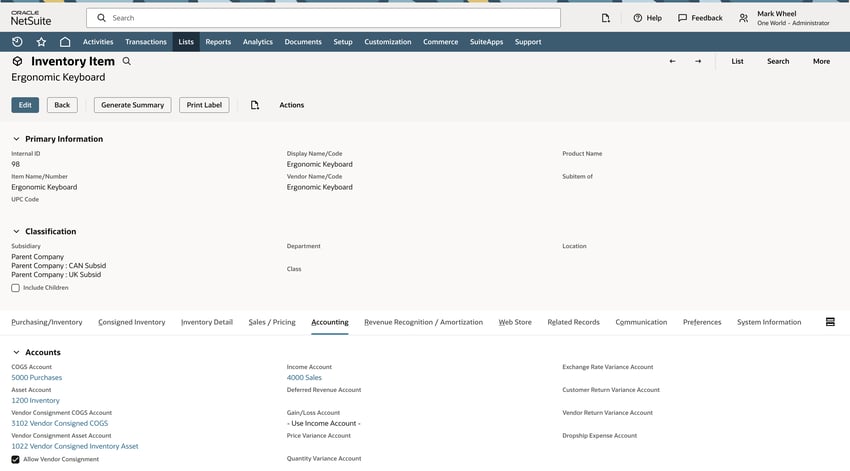
Vendor consignment—where suppliers own inventory stored at your facility until sold—addresses this challenge directly.
Understanding Vendor Consignment
Traditional inventory model:
- You purchase inventory from supplier
- You own stock immediately (asset on balance sheet)
- You bear all risk: obsolescence, shrinkage, value decline
- You pay supplier (typically 30-60 day terms)
- Capital committed whether stock sells quickly or sits for months
Vendor consignment model:
- Supplier ships inventory to your facility
- Supplier retains ownership
- Supplier bears risk
- You pay supplier only when inventory sells
- No capital commitment until point of sale
NetSuite Vendor Consignment Feature
The 2026.1 release introduces native vendor consignment capability, allowing efficient tracking and management of vendor-owned inventory.
Core functionality:
Consignment Inventory Tracking
System clearly segregates consignment from owned inventory:
- Inventory reports show owned and consignment quantities separately
- Consignment inventory not included in asset values
- System can include or exclude consignment when checking availability
- Track consignment inventory by location
Sale and Payment Trigger
When consignment inventory sells:
- Sales order fulfilment picks consignment inventory
- Ownership automatically transfers (triggered by fulfilment)
- System generates bill to supplier
- Cost of goods sold reflects supplier cost
The entire process automates—no manual journal entries required.
Consignment Reporting
Track consignment inventory performance:
- Inventory value by ownership
- Supplier consignment balances
- Consignment turnover analysis
- Aging for slow-moving consignment items
Practical Applications
New Product Line Testing: Test new product categories with supplier-owned inventory. Minimal capital investment until products sell. Make informed expansion decisions based on actual customer demand.
Seasonal Range Expansion: Arrange consignment for seasonal products. Offer complete seasonal range without excessive working capital commitment. Return unsold inventory to supplier after season.
Slow-Moving SKU Optimisation: Convert slowest-moving SKUs to consignment. Maintain customer service levels whilst freeing working capital for faster-turning inventory.
Why Vendor Consignment Matters
Capital efficiency: Scale product range without proportional working capital investment.
Risk mitigation: Shift obsolescence and market value risks to suppliers.
Supplier relationships: Offer suppliers expanded market access in exchange for consignment terms.
Strategic flexibility: Test new categories or market segments without major financial commitments.
Cash flow improvement: Pay suppliers when inventory sells rather than when it arrives.
Warehouse and Shipping Operations: Efficiency Enhancements
The 2026.1 release includes extensive improvements across warehouse management and shipping operations.
NetSuite Warehouse Management System (WMS) Enhancements
Kit and Non-Inventory Item Support
Search functionality now includes kit and non-inventory items, improving visibility and tracking accuracy.
Automated Landed Cost Validations
Rule-based validation during PO receipt with automated landed cost processing—reducing manual calculation and improving cost accuracy.
Inbound Shipment Reversal Support
Reverse inbound shipment transactions when receiving errors occur without complex workarounds.
Real-Time Back-Order Alerts
Receive immediate notification when component shortages will impact order completion—enabling proactive management.
NetSuite Ship Central Enhancements
Automated Barcode Scanning
Support for HIBC and GS1 barcode standards with automated item identification during packing—reducing picking errors and speeding packing.
Advanced Scanning with Real-Time Updates
Intelligent barcode format handling with real-time shipping data accuracy and full GS1 barcode data for traceability.
Pick-Up, Drop-Off (PUDO) Delivery Options
Support for PUDO delivery services with accurate tracking—offering flexible delivery options whilst maintaining tracking.
Bulk Shipment Processing Expansion
Process more than 10 shipments simultaneously for improved efficiency during peak periods.
Third-Party Billing Configuration
Configure third-party billing directly within sales order—preventing billing mismatches.
Manufacturing and Supply Chain Mobile App Enhancements
High-Quality Image Capture
Configurable option preserves original image resolution—critical for quality control, damage documentation, and compliance.
Configurable Pop-Up Behaviours
Define custom behaviours for pop-up close actions in mobile workflows—improving data accuracy.
iOS Browser Support
SCM mobile app now supports Apple iOS users through Safari and Chrome browsers—providing device flexibility.
Manufacturing Mobile: Flexible Operation Exit
Operators can exit active operations without badging out—supporting real-world scenarios whilst maintaining accurate time tracking.
Component Item Description Display
Manufacturing mobile displays item descriptions on component consumption page—reducing material selection errors.
NetSuite SuiteBilling: Advanced Subscription Management
Subscription and usage-based billing is increasingly relevant for service-based business models.
Shared Commitment Credits Across Services
Manage commitment credits across multiple usage-based services with per-service overage rates.
Scenario: Customer commits to monthly minimum across bundled services. Usage exceeding commitment incurs overage charges, but overage rates differ by service type.
System tracks usage across all services against single commitment, automatically calculates overages by service type, applies appropriate overage rates, and generates billing automatically.
Centralised Prepaid Balance Management
Manage prepaid balances centrally and apply across multiple subscriptions for single customer.
Customer manages single prepaid account rather than multiple service-specific balances. Your billing team maintains single prepaid balance rather than reconciling across multiple accounts.
Advanced Cohort Analysis
Subscription metrics dashboard includes cohort analysis with heat map visualisations.
Analyse customer cohorts to identify which segments demonstrate highest retention, what configurations minimise churn, how pricing impacts renewal rates, and where proactive engagement prevents cancellation.
Why Subscription Billing Matters
Recurring revenue visibility: Subscription models provide predictable revenue streams.
Customer relationship depth: Recurring services create ongoing engagement.
Cash flow management: Prepaid and commitment structures improve working capital.
Competitive differentiation: Flexible subscription models differentiate from transaction-only competitors.
E-Commerce and Connector Enhancements
NetSuite Connector for Loop Returns
Automate returns data flow from Shopify into NetSuite via Loop returns platform:
- Automatically create return authorisations
- Generate item receipts and cash refunds
- Maintain accurate inventory and financial data
- Eliminate manual returns processing
NetSuite Connector for Shopify: B2B Order Edit Synchronisation
Bidirectional synchronisation for order edits in Shopify B2B—changes in NetSuite synchronise to customer portal automatically.
Next Steps
Want to explore how these operational enhancements could transform your business?
Project Salsa specialises in NetSuite implementations for New Zealand businesses. Our team combines NetSuite platform expertise with industry knowledge to help you optimise operations effectively.
Learn more about all the updates in NetSuite 2026.1
This is just a summary of a few of the game-changing features in NetSuite 2026 Release 1. Read more about this release in the release notes. Most importantly, don't forget to request your Release Preview test account so you can get hands-on access and see how new features will work with your data, workflows, and customisations.
The preceding is intended to outline the Oracle NetSuite general product direction. It is intended for information purposes only and may not be incorporated into any contract. It is not a commitment to deliver any material, code, or functionality, and should not be relied upon in making purchasing decisions. The development, release, timing, and pricing of any features or functionality described for Oracle’s products may change and remains at the sole discretion of Oracle Corporation.