


How intelligent automation and fraud detection capabilities help businesses close faster and protect cash flow
The Month-End Burden: A Familiar Challenge
For businesses across New Zealand, month-end close often becomes a sprint to the finish line. Finance teams juggle hundreds of transactions—supplier invoices, intercompany eliminations between locations, complex GST reconciliations—all whilst trying to produce timely management reports.
The result? Late nights, manual spreadsheet reconciliations, and reports that arrive too late to influence operational decisions. For businesses managing multiple locations or complex supply chains, this administrative burden directly impacts your ability to scale.
NetSuite's 2026.1 release introduces AI-powered capabilities specifically designed to accelerate financial close whilst strengthening controls—capabilities particularly valuable for New Zealand businesses navigating multi-location operations and growing transaction volumes.
NetSuite Intelligent Close Manager: Your AI-Powered Close Assistant
The traditional close process problem:
Your finance controller manually tracks dozens of close tasks across a shared spreadsheet. Who's completed the bank reconciliation? Has someone reviewed the foreign exchange revaluations? Are we on track to close by day 5?
These questions consume hours of coordination time each month, with finance teams chasing updates rather than analysing results.
How NetSuite Intelligent Close Manager changes the game:
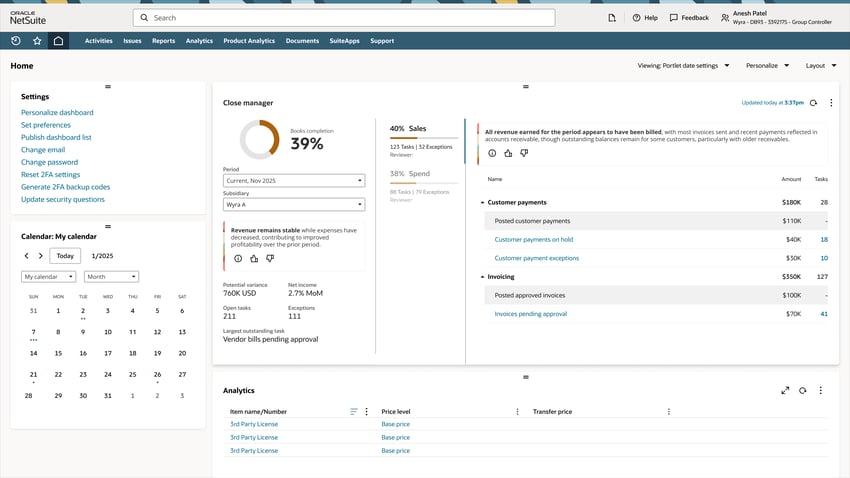
The new Intelligent Close Manager provides AI-powered, data-driven monitoring that keeps teams on track for a timely close.
Real-Time Progress Visibility
Finance teams can gauge close progress at a glance through an intuitive dashboard. No more spreadsheet status meetings—everyone sees exactly where things stand, which tasks are complete, and what's blocking progress.
Built-In AI Insights
The system automatically:
- Highlights trends: "Your inventory reconciliation is taking 30% longer than last month—here's why"
- Flags errors: "Three journal entries have unbalanced subsidiaries"
- Projects completion: "Based on current progress, you're on track to close by day 4"
- Identifies focus areas: "These five tasks represent 80% of remaining close time"
Hyperlinked Tasks Minimise Friction
Direct links from the close dashboard to specific tasks eliminate constant clicking between screens. When the system flags an issue with intercompany eliminations, one click takes you directly to the transaction requiring attention.
Why This Matters for Growing NZ Businesses
Faster decisions: When you close by day 3 instead of day 8, you have five additional days to analyse trends and adjust operational decisions—critical when managing operations with extended lead times or variable costs.
Better cash flow visibility: Businesses with significant weekly purchases or variable costs need current financial data to manage working capital. Faster close means earlier visibility into cash requirements.
Reduced compliance risk: With accurate, timely financial data, you're better positioned for GST returns, annual audits, and potential acquirer due diligence.
Enhanced Fraud Detection: Protecting Your Cash Flow
Payment fraud represents a growing threat for New Zealand businesses, particularly those with high supplier payment volumes. Businesses processing hundreds of supplier invoices monthly create numerous opportunities for fraudulent manipulation.
NetSuite Exception Management: Payment Risk Detection
The 2026.1 release introduces intelligent payment risk detection that flags potentially fraudulent activity by monitoring critical vendor data fields.
How it works in practice:
Someone with system access changes the bank account details for a major supplier three days before a $45,000 payment is due.
Previously, this change might go unnoticed until after the payment processed. The fraudulent payment leaves your account, the real supplier never receives payment, and you're out $45,000 whilst scrambling to sort the mess.
With Exception Management's payment risk detection:
- The system automatically flags the vendor record change because it occurred near a payment event
- Finance receives an alert: "Bank account modified for Vendor ABC, payment of $45,000 scheduled 14 Feb"
- The team investigates before processing payment, discovering the fraudulent change
- Crisis averted, funds protected
Specific value for NZ businesses:
- Protect large supplier payments, particularly for overseas suppliers where recovery would be extremely difficult
- Secure payments to critical vendors across all business operations
- Monitor vendor changes across all subsidiaries from a central view
The system doesn't prevent legitimate vendor updates—it simply adds a verification step when changes coincide with payment timing, creating a critical control without adding administrative burden.
AI-Enhanced Bank Reconciliation: From Hours to Minutes
Bank reconciliation sits at the intersection of two critical needs: accurate financial reporting and effective cash management. For businesses processing hundreds of transactions weekly, manual reconciliation consumes valuable accounting capacity.
The Traditional Reconciliation Challenge
Your accountant downloads the bank statement. This month, there are 287 transactions—purchases, wages, supplier payments, customer receipts.
She begins the manual matching process, clicking through to confirm each transaction, searching for matches, and investigating variances. Three hours later, 90% of transactions are matched. The remaining 10%—the exceptions—will consume another two hours of investigation.
Bank Transaction Matching with Generative AI
NetSuite 2026.1 introduces generative AI capabilities that fundamentally transform bank reconciliation:
Richer Data Extraction
The AI engine extracts more structured, detailed information from bank statement data—going beyond basic transaction descriptions to understand payment references, invoice numbers, and contextual details.
Intelligent Auto-Matching
This enhanced data strengthens the auto-match engine, resulting in significantly higher successful matches. What previously required manual investigation now matches automatically.
Faster Exception Resolution
For transactions that do require investigation, the AI-extracted details provide better context, accelerating resolution.
Value for businesses with:
- High transaction volumes across multiple bank accounts
- Foreign currency transactions with complex reference information
- Varied transaction types requiring intelligent matching
- Multiple locations requiring consistent reconciliation across finance teams
Streamlined Vendor Payments: NetSuite Intelligent Payment Automation
Managing vendor payments across multiple subsidiaries creates administrative complexity—particularly for growing businesses operating across multiple locations.
The Multi-Subsidiary Payment Challenge
Consider this scenario:
- Your Auckland subsidiary orders from Supplier A
- Your Christchurch subsidiary also orders from Supplier A
- Your Wellington subsidiary also orders from Supplier A
Traditional ERP systems often require three separate vendor records, leading to duplicate vendor maintenance, fragmented payment processing, complex reconciliation, and higher risk of payment errors.
Multi-Subsidiary Vendor Support
The 2026.1 enhancement to NetSuite Intelligent Payment Automation (powered by BILL) allows organisations to pay vendor bills from all subsidiaries linked to a single vendor record.
Practical benefits:
-
Simplified vendor management: One vendor record serves all subsidiaries, eliminating duplicate maintenance.
-
Consolidated payment processing: Process all payments to a vendor across subsidiaries in a single workflow.
-
Improved supplier relationships: Suppliers receive single payments covering all subsidiary obligations.
-
Better cash flow management: Centralised visibility into all vendor obligations enables more strategic payment timing.
-
Enhanced controls: Single vendor records reduce the risk of fraudulent duplicate vendor schemes whilst maintaining subsidiary-level reporting.
Additional Financial Management Enhancements
Beyond these headline features, the 2026.1 release includes several improvements valuable for NZ businesses:
Improved Elimination Functions
Drill down into source transactions for all balance sheet elimination journal entries—critical for businesses with intercompany transactions between locations.
Enhanced Reconciliation Rules
Apply reconciliation rules to existing unmatched data on demand, with date controls—helping clear reconciliation backlogs more efficiently.
Suite Approvals for Journal Entries
Approve and manage journal entries with enhanced visibility, with configurable controls over when entries are locked or reopened during approval.
NetSuite Cash 360 Enhancements
Support for sales orders with billing schedules delivers more precise cash forecasts—particularly valuable for businesses with staged billing arrangements.
Flexible Bank Feed Scheduling
Define custom scheduled imports for bank data, with on-demand refresh capability for real-time visibility.
Next Steps
The NetSuite 2026.1 release demonstrates Oracle's continued investment in AI-powered automation that addresses real-world finance challenges. For New Zealand businesses managing complex operations, these capabilities offer tangible time savings and enhanced controls.
Want to explore how these features could transform your financial close process?
Contact Project Salsa to discuss:
- How Intelligent Close Manager could accelerate your month-end process
- Whether your business would benefit from enhanced fraud detection
- Implementation approaches for AI-enhanced bank reconciliation
- Migration strategies if you're currently using a legacy ERP system
Learn more about all the updates in NetSuite 2026.1
This is just a summary of a few of the game-changing features in NetSuite 2026 Release 1. Read more about this release in the release notes. Most importantly, don't forget to request your Release Preview test account so you can get hands-on access and see how new features will work with your data, workflows, and customisations.
The preceding is intended to outline the Oracle NetSuite general product direction. It is intended for information purposes only and may not be incorporated into any contract. It is not a commitment to deliver any material, code, or functionality, and should not be relied upon in making purchasing decisions. The development, release, timing, and pricing of any features or functionality described for Oracle’s products may change and remains at the sole discretion of Oracle Corporation.