

This guide is for CFOs, Finance Directors, and Operations leaders at New Zealand wholesale distributors who are weighing up an ERP decision or starting to question what their current system is actually costing them.
We walk through every cost category that matters: software, infrastructure, implementation, ongoing maintenance, upgrade projects, internal resourcing, and the operational costs that rarely appear in vendor proposals. All of it in the context of what a wholesale distribution business with $50m to $200m in revenue actually experiences.
Why TCO Conversations are Often Incomplete
When your finance team evaluates an ERP, the initial comparison tends to focus on the upfront numbers: licence fees, implementation costs, and annual support. This is understandable. They are the most visible line items in a proposal.
For wholesale distributors with tight margins, multi-warehouse complexity, and high SKU volumes, the costs that accumulate after go-live often dwarf the initial investment. A perpetual licence looks cheap on day one. By year three, the picture has changed considerably.
That is why the five-year total cost of ownership calculation matters.
The Cost Iceberg: What Sits Below The Surface
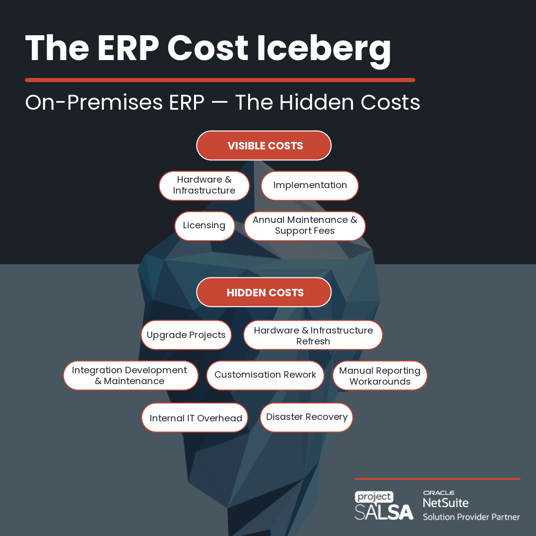
Think of ERP costs as an iceberg. The visible portion is what gets discussed in procurement: software licence and implementation fees. The rest sits below the waterline and shows up over the years that follow.
On-premises ERP: the Full Ongoing Cost Stack
For distributors running on-premises ERP systems, including the legacy platforms common in New Zealand, the full cost picture typically includes:
-
Perpetual Licence and Maintenance Fees: $80,000 to $250,000+ depending on user count and modules
-
Hardware and Infrastructure: $40,000 to $120,000 upfront, with a full hardware refresh every five years
-
Upgrade Projects: $5,000 - $10,000 every year to stay on a supported version
-
Internal IT Resourcing: 0.5 to 1.5 FTE to manage servers, backups, and ERP administration
-
Customisation Rework: each upgrade cycle can require significant redevelopment of modifications that broke during the upgrade
-
Business Continuity and Disaster Recovery: $15,000 to $60,000 in separate DR infrastructure and ongoing testing overhead
-
Ongoing Support Consulting Fees: On-premises ERP systems are typically not do it yourself in nature so work on the system often requires input from your implementation partner. This often costs about $10,000 per year in consulting fees.
The Server Upgrade Problem
For many distributors, the server upgrade cycle is when the true cost of on-premises ERP becomes impossible to ignore. Hardware has a finite lifespan. When your server reaches end of life, you face a capital expenditure that has nothing to do with getting better functionality or fixing a business problem. You are simply paying to keep the lights on.
That bill lands at the same time your ERP vendor may be telling you that your software version is reaching end of support, which means a second project cost sitting right behind the first. Fund the server upgrade, fund the software upgrade, or ask a harder question: should this money be going towards a platform that does not have either of those costs?
Most businesses defer both for as long as possible because the disruption and combined cost is significant. That creates technical debt, security exposure, and a growing gap between what the system can do and what modern distribution operations require.
Distributors on outdated ERP versions often find themselves locked out of new integrations. EDI, 3PL connectivity, and B2B portal functionality frequently require modern API frameworks that older systems cannot support. The cost of staying still is real, even if it does not show up on a budget line.
Cloud ERP TCO (Total Cost of Ownership): How the Model Changes
Oracle NetSuite, which serves more than 43,000 businesses across 220 countries and territories, operates on a fundamentally different cost model. Instead of perpetual licences and periodic upgrade projects, you pay an annual subscription that covers:
-
Software access across all licensed modules
-
Infrastructure, hosting, and uptime management
-
Two major releases per year, applied automatically
-
Security patching and compliance updates
-
Built-in redundancy and disaster recovery
That changes the cost structure in ways that matter when you run the five-year numbers.
Implementation Costs: Lower than On-premises, and Higher in Value
Experienced NetSuite partners typically scope wholesale distribution implementations between $60,000 and $150,000 depending on warehouse count, integration complexity, and customisation requirements. That is generally lower than a comparable on-premises implementation for a business of similar size.
The more important distinction is scope. A well-run implementation delivered by a partner with genuine distribution expertise, including pre-built EDI connectors, 3PL integration patterns, and warehouse management configuration, means you go live with functionality that would take years to bolt on to a legacy system.
The implementation cost is not just a migration. It is a capability uplift.
What the Subscription Covers
NetSuite subscription pricing is based on the modules licensed, user count, and contract term. Costs vary depending on the size and complexity of your business, and your implementation partner will provide a tailored quote based on your specific requirements.
There is no separate maintenance fee, no upgrade project budget to hold in reserve, and no hardware refresh cycle. Outside of implementation and any ongoing development work, the subscription covers your software costs.
Five-year TCO: Side by Side
The comparison below is based on a mid-market New Zealand wholesale distributor: $50m to $120m revenue, two to four warehouses, 30 to 80 ERP users, moderate customisation, and EDI integration with one or more major retail customers.
|
|
On-Premises ERP | Cloud ERP NetSuite |
| Software Licence | Perpetual licence | Included in subscription |
| Implementation & Consulting | Higher upfront cost | Lower upfront cost |
| Annual maintenance & subscription | Annual maintenance fee on top of licence | Annual subscription, no maintenance fee on top |
| Server & Infrastructure | Upfront cost + refresh every 5 years | $0 |
| Upgrade Projects | Full project cost every 2–3 years | Automatic, no project cost |
| 5-Year Total Cost Estimate | $600k–$1.4m+ | $210k–$900k |
Important note: These are indicative cost ranges based on market experience. Your actual TCO will depend on system complexity, vendor selection, implementation partner, and internal IT capability. We recommend requesting a detailed TCO analysis as part of any ERP evaluation process.
The Costs That Do Not Appear in Any Vendor Proposal
Beyond direct software and infrastructure costs, there is a category of operational costs that builds up over time and almost never appears in a vendor proposal. For wholesale distributors, these can be substantial.
The Excel Tax
When your ERP cannot produce the reports your management team needs, by warehouse, by product category, by customer margin, by landed cost, someone fills the gap with Excel. This is not a minor inconvenience. Finance teams at distributors running legacy systems often find themselves exporting data into spreadsheets just to produce basic reports. Ledge's 2025 month-end close benchmarks report found that 94% of finance teams still rely on Excel for close activities, and half cite it as a key reason their close takes longer than it should.
The cost is real: finance staff time, error risk, and delays in getting numbers to leadership. Boards increasingly expect real-time visibility. A system that requires three days of spreadsheet work to produce a P&L is a competitive problem.
Integration Friction
Modern wholesale distribution depends on tight integration: EDI with major retail customers, 3PL systems for third-party fulfilment, carrier APIs for freight booking and tracking, B2B portals for customer self-service, and bank feeds for automated reconciliation.
Building and maintaining these integrations on legacy platforms requires ongoing custom development. Each upgrade cycle can break integrations that were working. Each new trading partner requirement triggers a development project.
Cloud ERP built on open API architecture, with pre-built connector frameworks for EDI, 3PL, and carrier integration, changes this. Integration becomes configuration, not development.
The Month-end Close
Distributors running multi-entity or multi-warehouse operations often spend three to five days closing their books each month. That is not just a finance team inconvenience. Time spent on manual reconciliation, intercompany eliminations, and consolidated reporting delays the financial intelligence your leadership team needs.
Cloud ERP with automated intercompany accounting, real-time consolidation, and same-day close capability returns that time to your finance team. For a business with a four-person finance function spending 30% of their time on close activities, the annual time saving runs into weeks.
In a separate ROI study, Nucleus Research also found NetSuite customers accelerated financial close times by up to 50%.
Inventory Blind Spots
For distributors, inventory accuracy ties directly to revenue and margin. Stockouts cost you sales and customer trust. Overstock ties up working capital and erodes margin through markdowns or write-offs.
Legacy ERP systems without real-time multi-location inventory visibility, including accurate available-to-promise calculations across warehouses, create recurring inefficiencies. The cost shows up as lost sales from preventable stockouts, excess stock in one location while another runs short, manual reorder processes that lag behind actual demand, and EDI non-compliance penalties from major retail customers. The same Nucleus Research study found inventory turns improved by 50% among NetSuite customers.
When Legacy ERP Starts to Constrain Growth
There is a growth point at which legacy ERP systems stop being a friction cost and start actively limiting what a distribution business can do. For most New Zealand wholesale distributors, that point appears somewhere in the $50m to $100m revenue range.
Below that threshold, the workarounds are manageable: extra spreadsheets, some manual reconciliation, a custom report when needed. Above it, the workarounds become structural constraints.
-
Adding a new warehouse or depot takes months of custom development rather than configuration
-
Launching a B2B customer portal requires a separate system that needs building and maintaining
-
Onboarding EDI trading partners is a project, not a repeatable process
-
Multi-currency and multi-entity operations strain systems that were not designed for that complexity
-
Real-time inventory visibility across locations requires bolt-on tools that rarely integrate cleanly
The cost of these constraints does not always appear on a budget line. It shows up in slower customer onboarding, competitive disadvantage against peers with better service levels, and management time spent working around system limits rather than running the business.
What a TCO Analysis Should Include: A Checklist for Finance Leaders
If you are running a rigorous ERP evaluation, your TCO model should cover all of the following.
Direct costs over five years
-
Software: total licence or subscription fees
-
Implementation: all consulting and project costs, including change management
-
Infrastructure: hardware, hosting, network, and refresh cycles
-
Support and maintenance: annual fees and contract terms
-
Upgrade projects: budgeted upgrade cycles for on-premises options
Indirect and operational costs
-
Internal IT resourcing: FTE cost attributable to ERP administration
-
Finance team overhead: time spent on manual processes that the system should handle
-
Integration development: cost to build and maintain connections to EDI, 3PL, and other systems
-
Customisation maintenance: annual cost to keep custom code current
-
Training: initial and ongoing as the system evolves
Risk and opportunity costs
-
Compliance risk: exposure from operating on unsupported software
-
Business continuity: cost and resilience of your disaster recovery posture
-
Opportunity cost: growth limited by system constraints, including new warehouses, new entities, new channels
-
Talent risk: difficulty attracting finance and operations staff who expect modern tooling
The Project Salsa Perspective
Project Salsa is a NetSuite implementation partner and part of the Verde Group, a New Zealand business with deep roots in ERP for distribution and wholesale. The Verde Group's history in ERP for distribution businesses means we know where legacy systems fail and what a well-implemented cloud ERP looks like in practice.
We work with distributors across the $15m to $200m revenue range. Our implementation approach is built around the requirements of New Zealand distribution operations: multi-warehouse inventory management, landed cost accuracy, EDI integration with major retail chains, B2B portal capability, and the financial consolidation that comes with multi-entity structures.
We do not lead with technology. We lead with the outcome: cut stockouts, protect margin, promise delivery.
Ready to See What it Looks Like for your Business?
Every distribution business has a different cost profile, a different set of integrations, and a different growth picture. A discovery call with our team takes about 30 minutes and gives you a clear read on where your current system is costing you, what a move to NetSuite would realistically involve, and whether it makes sense for your business right now. No pitch, no pressure.
Contact us to book yours.
Frequently Asked Questions
Is cloud ERP always cheaper than on-premises over five years?
For most mid-market distributors in the $50m to $200m revenue range, yes, when you include the full cost stack. The subscription model removes hardware, upgrade projects, and maintenance fees from the equation. Based on the cost model set out above, cloud ERP is typically 40 to 65% lower in total five-year cost than a comparable on-premises deployment, depending on the complexity of your environment. Panorama Consulting Group's 2026 ERP Report notes that SaaS ERP shifts responsibility for system maintenance and upgrades to vendors, reducing customers' infrastructure and upgrade burden — the primary driver of that cost difference. Businesses with highly specialised customisation requirements or very large user counts may see a different picture, which is why a tailored TCO model matters.
What happens to our customisations when we migrate?
This is one of the most important questions to ask any implementation partner. NetSuite's customisation framework, SuiteScript and SuiteFlow, is designed to survive upgrades without rework. Traditional ERP customisation is typically built directly on the system codebase, so it breaks during upgrades and needs to be rebuilt. NetSuite customisations sit in a separate layer. That architectural difference has direct cost implications over time
How do we handle the transition from our current ERP?
A structured migration plan covers data migration (master data, open transactions, historical records), integration cutover for EDI, 3PL, and banking, user training, and a parallel run period where appropriate. An experienced implementation partner will have a repeatable methodology for this. Ask to see their migration playbook and speak to reference customers in comparable distribution businesses.
What about the NetSuite subscription cost increasing over time?
NetSuite subscription pricing can increase on renewal, and the rate varies depending on your contract terms and negotiation. One practical advantage of NetSuite is that multi-year contracts lock in your pricing for the duration of the term, giving you cost certainty that on-premises ERP simply cannot offer. On-premises infrastructure tends to face large, unpredictable step-change costs at upgrade and hardware refresh cycles. A multi-year NetSuite subscription means you know exactly what you are paying, and for how long.
When evaluating any ERP, it is worth asking your implementation partner to walk you through the contract structure and renewal terms before you sign.
How does this apply specifically to New Zealand businesses?
New Zealand distributors have specific requirements: GST compliance, NZ bank feed integration, NZD multi-currency handling for import operations, and integration with NZ-specific logistics providers. A NetSuite partner with genuine NZ distribution experience, rather than a generic global template, will configure these correctly from the outset rather than discovering the gaps after go-live.
Disclaimer: Cost estimates in this article are indicative only and based on market experience with mid-market distribution businesses in New Zealand and Australia. Actual costs will vary significantly based on business complexity, vendor selection, and implementation scope. This content reflects information available at the time of publication. Oracle NetSuite product direction, pricing, and features are subject to change. Always request a formal proposal and reference check from your chosen implementation partner.