


Real-Time Visibility, Cost Control and Customer Service—Measured and Managed
Ask any logistics manager what keeps them up at night. The answers are consistent: late deliveries, picking errors, rising freight costs, slow inventory turns and poor visibility into daily operations. These aren't just operational irritations—they directly impact customer satisfaction, cash flow and profitability.
The challenge for most New Zealand transport and logistics operators isn't knowing which metrics matter. It's getting accurate, timely data from systems that were never designed to provide integrated visibility. When warehouse, transport and finance systems run independently, pulling together meaningful KPIs becomes a manual, time-consuming task. By the time the report is finished, the data is often already outdated.
Modern cloud ERP changes this. It unifies inventory, warehouse, order and financial data on one platform, with seamless integration to transport management systems. The result is real-time visibility into the metrics that drive performance and customer satisfaction.
Below are the seven most impactful logistics KPIs for NZ operators — why they matter, and how integrated systems make them manageable, not just measurable.
The 7 KPIs That Define Logistics Excellence
1. On-Time, In-Full (OTIF) Delivery Performance
What it measures: The percentage of customer orders delivered on the promised date, with the complete quantity ordered, in acceptable condition.
Why it matters: OTIF is the single metric that captures your ability to meet customer commitments. Every percentage point improvement in OTIF translates to stronger customer relationships, reduced expediting costs and fewer service recovery situations. Conversely, poor OTIF performance drives customer churn and erodes your reputation in the market.
How NetSuite improves it: When inventory management, order processing and transport planning operate on a unified platform, you gain unprecedented visibility into potential OTIF failures before they occur. The system automatically validates inventory availability against customer orders, flags shortages immediately and surfaces transport delays in real time.
Exception alerts notify planners the moment a shipment risk emerges—a carrier running late, inventory allocated but not yet picked, or a customer delivery window about to be missed. Rather than discovering OTIF failures after the fact during customer complaints, you're alerted to intervene proactively.
Integration with transport management systems means promised delivery dates are based on actual lead times and carrier performance, not optimistic guesses. When circumstances change—weather delays, vehicle breakdowns, inventory shortages—the entire system updates immediately, allowing customer service teams to manage expectations proactively.
2. Warehouse Pick Accuracy
What it measures: The percentage of order lines picked correctly—right product, right quantity, right condition—first time, without requiring correction.
Why it matters: Pick accuracy directly determines customer satisfaction, operational efficiency and cost. Every picking error triggers a cascade of waste: customer service calls, return freight, restocking labour, expedited re-shipments and potential customer loss. Even a 2-3% pick error rate can represent thousands of dollars in monthly waste for a mid-sized operation.
How NetSuite improves it: Integrated warehouse management functionality transforms picking from a paper-based, error-prone process to a system-directed, validated workflow. Mobile RF scanners guide pickers to exact bin locations. Barcode scanning validates that the correct item is being picked before allowing the user to proceed. Quantity verification prevents over- or under-picking.
The system can enforce pick validation rules—requiring lot number confirmation for serialised inventory, weight verification for bulk items, or photographic evidence for high-value goods. Pick accuracy becomes a process outcome, not a training challenge.
Real-time dashboards show pick accuracy by warehouse, shift, picker and product category, allowing managers to identify and address systematic issues quickly. When pick accuracy does slip, the integrated system makes root cause analysis straightforward—was it a new picker, a similar-looking SKU, or a bin labelling issue?
3. Warehouse Throughput (Lines Picked Per Hour)
What it measures: The number of order lines successfully picked, packed and ready for dispatch per labour hour—the core productivity metric for warehouse operations.
Why it matters: Labour represents 50-65% of warehouse operating costs for most operators. Improving throughput by even 10-15% delivers immediate, measurable cost reduction whilst improving order cycle times. In tight labour markets like New Zealand's, productivity improvements through better processes and technology often matter more than simply adding headcount.
How NetSuite improves it: Sophisticated warehouse management capabilities optimise every element of the picking process. Wave planning batches orders intelligently based on pick density, shipping schedules and picker availability. Zone picking assigns pickers to specific warehouse areas to minimise travel time. Slotting algorithms position fast-moving products in prime locations close to packing stations.
Directed picking routes pickers through the warehouse via the most efficient path, eliminating wasted motion. Batch picking allows one picker to gather items for multiple orders in a single pass. Mobile devices provide turn-by-turn directions and real-time task assignments, keeping pickers productive without constant supervisor intervention.
Dock door scheduling coordinates picker productivity with carrier pickup times, ensuring completed orders move straight to vehicles without warehouse congestion. The result: more lines picked per hour, better space utilisation and reduced labour cost per order.
4. Freight Cost Per Order
What it measures: Total outbound freight expense divided by number of customer orders shipped—a critical metric for understanding delivery cost structure and identifying optimisation opportunities.
Why it matters: Freight costs represent one of the largest variable expenses for logistics operators, often ranging from 8-15% of revenue. Small improvements in freight efficiency—better carrier selection, improved load consolidation, optimised mode choice—directly impact profitability. Understanding freight cost at a granular level (per customer, per lane, per service type) enables strategic pricing and network optimisation decisions.
How NetSuite improves it: Integration between ERP and transport management systems creates a closed loop from order receipt through carrier selection, dispatch and cost accounting. The system can evaluate multiple carrier options against actual rates and service levels, automatically selecting the optimal carrier based on cost, transit time and reliability.
Load consolidation intelligence identifies opportunities to combine multiple orders into single shipments, reducing per-order freight cost. Parcel optimisation determines the most cost-effective packaging and carrier service for each shipment based on weight, dimensions and destination.
Because freight costs automatically flow to the general ledger and link to specific orders, operators gain instant visibility into freight cost per order, per customer and per lane. Margin analysis incorporates actual freight costs, not estimates, allowing accurate profitability assessment. When freight costs spike—fuel surcharges, peak season premiums, zone changes—the impact is immediately visible, enabling proactive customer communication or pricing adjustments.
5. Warehouse and Yard Dwell Time
What it measures: The time elapsed from when inventory arrives at your facility until it's available for picking (inbound dwell) or from pick completion until the order leaves your facility (outbound dwell).
Why it matters: Dwell time represents non-value-added delay in your operation. Extended inbound dwell means inventory sitting in receiving rather than being available for customer orders. Extended outbound dwell indicates bottlenecks in packing, staging or dispatch. Both directly impact order cycle time, inventory carrying costs and space utilisation. In a constrained warehouse environment, reducing dwell time effectively increases capacity without capital investment.
How NetSuite improves it: A unified system provides complete visibility into dwell time by tracking every inventory movement with timestamps—goods receipt, putaway completion, pick execution, pack completion, dispatch scan. Dashboards highlight dwell time by location, product category and time of day, revealing patterns that would be invisible in disconnected systems.
For example, if outbound dwell time spikes every afternoon, it might indicate dock door constraints or carrier pickup timing issues. If certain product categories consistently show extended inbound dwell, it might signal receiving workflow inefficiencies or quality inspection bottlenecks.
Real-time alerts can notify supervisors when dwell time exceeds acceptable thresholds, enabling immediate intervention. The integrated platform also connects dwell time to labour scheduling—if warehouse staffing drops but inbound receipts remain constant, dwell time will increase predictably, allowing proactive labour adjustments.
6. Inventory Turn Rate
What it measures: The number of times your average inventory investment is sold and replaced during a period—calculated as cost of goods sold divided by average inventory value.
Why it matters: Inventory turns directly reflect how efficiently you're using working capital. Higher turns mean less cash tied up in stock, lower carrying costs, reduced obsolescence risk and better warehouse space utilisation. For NZ operators, where distance from major markets makes inventory positioning critical but expensive, optimising turns is particularly important.
How NetSuite improves it: Real-time inventory visibility across all locations allows operators to see exactly what stock is moving, what's sitting idle and where inventory is positioned. Demand planning capabilities analyse historical consumption patterns and forecast future requirements, helping prevent both stockouts and excess inventory accumulation.
Multi-location inventory management enables sophisticated allocation strategies—keeping fast-moving items in all depots whilst consolidating slow-movers in central locations. Automated reorder points and safety stock calculations balance service level requirements against inventory investment.
The system can also identify obsolescence risks early—products with zero recent movement, seasonal items approaching end of season, or stock nearing expiration dates. Proactive alerts allow you to implement clearance strategies, return arrangements or customer promotions before inventory becomes a write-off.
Because the platform integrates inventory data with financial reporting, you can track turns by product category, supplier or depot, identifying specific opportunities for inventory reduction whilst maintaining service levels.
7. Return Rate and Reverse Logistics Efficiency
What it measures: The percentage of orders or shipments that result in customer returns, and the time and cost required to process those returns back into inventory or dispose of them.
Why it matters: Returns are expensive—return freight, inspection labour, restocking effort and potential disposal costs. High return rates often indicate underlying quality issues, picking errors or customer expectation mismatches. Slow return processing ties up capital in unusable inventory and creates customer service friction around refunds and credits.
How NetSuite improves it: Integrated returns management processes track returns from customer initiation through receipt, inspection, disposition and credit issuance. Return authorisations link directly to original orders, providing complete visibility into what was returned, why and what action was taken.
The system can analyse return patterns to identify systematic issues—specific products with high return rates, customers with unusual return behaviour or picking errors that drive returns. This intelligence allows targeted intervention: improve product descriptions, enhance quality control or provide additional picker training.
Return workflows can be automated based on business rules—high-value items require inspection before credit, certain product categories allow immediate credit upon scan, damaged goods route directly to disposal. This automation speeds processing and ensures consistent application of return policies.
Because return costs automatically flow to financial records and link back to original orders, operators gain visibility into true net profitability by customer and product after accounting for returns—critical data for pricing and customer management decisions.
Why Real-Time Dashboards Transform Decision-Making
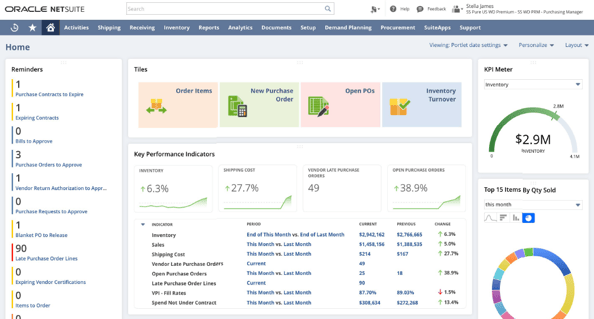 The power of tracking these KPIs on an integrated platform isn't just about having the numbers—it's about having them when they matter and in a format that drives action.
Traditional approaches require manually gathering data from multiple systems, reconciling inconsistencies, building spreadsheets and distributing reports that are outdated by the time they're reviewed. By then, OTIF failures have already disappointed customers, picking errors have already shipped, and cost overruns have already occurred.
Integrated ERP dashboards provide role-based, real-time visibility:
Operations managers see live OTIF status, warehouse throughput and dwell time by shift, with drill-down to specific exceptions requiring intervention.
Financial controllers monitor freight cost per order, inventory turns and margin by customer, with the confidence that numbers reconcile to the general ledger.
Depot managers compare performance across locations—which sites achieve best pick accuracy, lowest dwell time or highest throughput—enabling best practice sharing.
Executive leadership accesses consolidated KPIs across all entities and locations, with the ability to slice by customer, product category, service type or time period.
Exception alerts proactively notify the right people when KPIs fall outside acceptable ranges, transforming management from reactive firefighting to proactive intervention.
Frequently Asked Questions
Do we need full warehouse management capabilities to start tracking these KPIs? No. You can begin with inventory and order management modules, gaining visibility into inventory turns, OTIF and basic throughput metrics. Warehouse management capabilities (directed picking, wave planning, slotting) can be added as your maturity and requirements grow. Many operators implement WMS after establishing the foundation, targeting specific throughput and accuracy improvements once baseline operations are stable.
Will integrating ERP and TMS slow down our transport planning? The opposite typically occurs. Integration accelerates planning by eliminating manual data transfer between systems and providing transport planners with complete, accurate information about what needs to ship, from where and by when. Automated carrier selection, rate shopping and load optimisation actually speed planning whilst improving outcomes. The key is ensuring the integration is well-designed—Project Salsa specialises in connecting NetSuite with common TMS platforms used in the NZ market.
Can NetSuite support multi-entity operations across New Zealand? Yes. NetSuite's capability manages multiple legal entities, locations and depots on a single platform. You can track KPIs by individual entity whilst also viewing consolidated performance across the entire group. This is particularly valuable for operators who've grown through acquisition or manage separate subsidiaries for different service types—3PL, general freight, specialised transport—under one parent company.
How do we maintain performance during the transition period? A phased implementation approach minimises disruption by keeping existing operational systems running whilst building the new platform in parallel. Cut-over typically happens during a quiet period (weekend or slower seasonal window) for each module or location. Most operators maintain or slightly improve KPIs during implementation because the process itself surfaces inefficiencies and drives operational focus.
The Visibility Imperative
In an industry where margins are measured in single percentage points, the difference between operators who thrive and those who struggle often comes down to visibility and control. You can't improve what you can't measure, and you can't measure effectively on disconnected systems that require manual data gathering and reconciliation.
The seven KPIs outlined here aren't theoretical metrics—they're the practical measures that determine whether you're delivering on customer commitments, using resources efficiently and operating profitably. Modern integrated ERP makes them not just visible but actionable in real time.
The question isn't whether to improve your operational visibility. It's whether to continue managing with yesterday's data or start making decisions based on what's actually happening right now.
Build Dashboards Your Entire Team Will Use
Project Salsa specialises in helping New Zealand transport and logistics operators implement NetSuite with a focus on the KPIs that drive operational and financial performance. We don't just deploy software—we work with your team to define the metrics that matter, build dashboards that inform decision-making and establish processes that turn data into action.
Our implementation approach is phased and practical, designed to deliver early visibility improvements whilst building toward comprehensive integration. We understand the NZ logistics landscape—the depot networks, the operational challenges, the regulatory environment—and design solutions that fit your reality.
Want KPI dashboards that your operations managers and CFO both actually use? Contact Project Salsa to discuss how we can blueprint and implement NetSuite for your operation—or explore our Transport & Logistics page to learn more about our approach.