


Phantom stock is inventory your system says you have, but that does not physically exist. For NZ wholesale distributors, it causes stockouts, misfulfilled orders, and eroded customer trust. This article covers the seven most common root causes and how modern cloud ERP like NetSuite helps eliminate them.
What is Phantom Stock?
Phantom stock is a specific type of inventory discrepancy. Your ERP or inventory system shows units on hand. Your warehouse does not have them.
Unlike a straightforward stockout where your system correctly shows zero, phantom stock is a silent problem. Your team promises availability, your system confirms it, and then the order cannot be fulfilled. By the time the error surfaces, the damage is already done.
For wholesale distributors managing thousands of SKUs across multiple locations, phantom stock is not a minor inconvenience. It is a systemic accuracy failure that compounds across every order cycle.
The good news is that phantom stock is not random. It has causes, and those causes are fixable.
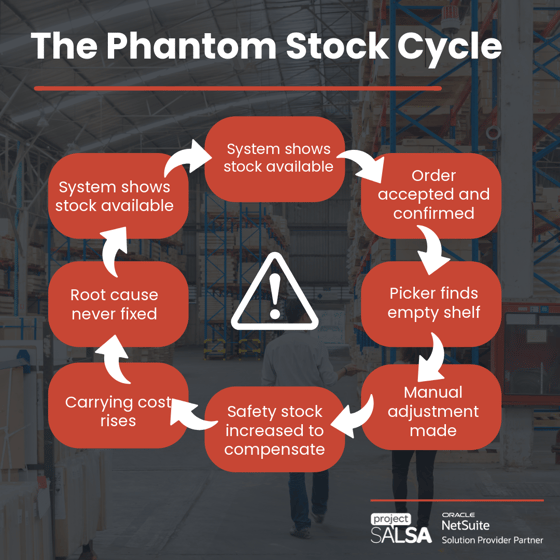
Why Phantom Stock Is a Pre-Stocktake Warning Sign
Many NZ distributors discover phantom stock at stocktake time. The physical count does not reconcile with the system. Adjustments are made. Everyone moves on.
But stocktake corrections are not a solution. They are a confirmation that inventory accuracy has been deteriorating in between counts. If your team is manually reconciling significant variances every stocktake, the business is already absorbing the cost of those errors in misfulfilled orders, excess safety stock, and write-offs.
Addressing the root causes below is how you reduce those variances before they reach stocktake.
7 Causes of Phantom Stock in Wholesale Distribution
1. Manual Data Entry Errors
This is the most common cause and the hardest to argue against. When stock movements rely on keyboard input, human error is guaranteed at scale.
A receiving team enters 100 units instead of 10. A warehouse operator picks from the wrong bin and logs it against the right item. A despatch team ships a substitution without updating the system. Each individual error is small. Across 500 daily transactions, the cumulative effect on inventory accuracy is significant.
The issue is not people. It is the process. Any workflow that requires manual data entry to maintain inventory accuracy will degrade over time.
What fixes it: Scan-based receiving and picking workflows that capture stock movements at the point of transaction, not after the fact. NetSuite WMS with barcode scanning eliminates the manual entry step entirely for receiving, put-away, picking, and despatch.
2. Receiving Processes That Are Delayed or Incomplete
Stock that arrives in your warehouse but has not been receipted in your system does not exist as far as your ERP is concerned. However, items may be picked and shipped from that unreceipted stock before the receiving process is complete.
The result is negative inventory positions, which often get corrected through manual adjustments. Those adjustments may or may not reflect where inventory actually sits.
This issue is most common in busy receiving docks where physical processing happens faster than system updates, or where staff treat system receipting as a back-office function rather than a warehouse operation.
What fixes it: Mobile receiving workflows that allow warehouse staff to receipt goods in the system at the moment of physical receipt, using tablets or handheld scanners at the dock.
3. Unrecorded Shrinkage
Shrinkage covers theft, damage, spoilage, and evaporation. In wholesale distribution, the most common forms are unreported transit damage, broken units removed from stock without a write-off, and slow deterioration of perishable or time-sensitive goods.
If your team removes damaged goods from a shelf without logging a stock adjustment, your system count stays unchanged. That inventory no longer exists, but it will be promised to the next customer who orders it.
Many distributors underestimate the cumulative impact of shrinkage because individual incidents are small. Across a warehouse with thousands of SKUs, it adds up to meaningful inventory inaccuracy.
What fixes it: A clear operational process for recording write-offs and adjustments at the point of discovery, supported by system workflows that make logging a damaged item as fast as throwing it away. When this is easy to do, staff do it.
4. Returns Processed Incorrectly
Customer returns are one of the most error-prone workflows in any distribution operation. A return arrives, it is restocked, but the system transaction is not completed correctly. The item goes back to a shelf as available inventory, but the return receipt has not been processed, or it has been processed against the wrong SKU or location.
In some cases, returned goods are restocked without any inspection. Damaged items re-enter available stock. Orders are picked against them. The customer receives goods that should never have been available.
What fixes it: A structured returns management process with mandatory system receipt before any item is restocked. In NetSuite, this is the Return Merchandise Authorisation (RMA) workflow. Every return is tied to an original order, graded on receipt, and either restocked, quarantined, or written off based on condition, before it appears in available inventory.
5. Inaccurate Bin Locations and Poor Warehouse Organisation
Items in the wrong bin are one of the most frustrating sources of phantom stock because the inventory exists, but it cannot be found. If an item is in bin B-12 but the system says C-04, a picker will confirm the C-04 location is empty, assume a stockout, and the system count will likely be adjusted down.
Over time, bin location inaccuracies create a version of phantom stock in reverse: your system shows less than you physically have, or it shows availability in a location where stock does not exist.
This is especially common in warehouses that have grown organically, where locations have been added, moved, or renamed without corresponding system updates.
What fixes it: Directed putaway rules in your WMS that assign bin locations systematically, and cycle counting programmes that verify bin-level accuracy on a rolling basis rather than waiting for annual stocktake.
6. Kitting and Light Assembly Not Tracked at the Component Level
Many NZ distributors assemble or kit products from components. Kits are a particularly common source of phantom stock because the components and the finished kit may both appear in your inventory system, depending on how the assembly process is managed.
If a team assembles 20 kits but only receipts the finished kit without consuming the components, your system shows both 20 kits and the components that should have been consumed. If the reverse happens and components are consumed without the kit being receipted, you have no record of the finished goods.
Either scenario produces inventory counts that do not match physical reality.
What fixes it: Work order or assembly order workflows in NetSuite that explicitly consume component inventory and create finished goods receipts as part of the same transaction. This prevents assembly from happening outside the system.
7. Poor Integration Between Systems
Many distribution businesses run separate systems for order management, warehouse management, and finance, connected by manual exports, scheduled syncs, or middleware integrations. Every integration point is a potential lag or failure.
If your WMS updates stock positions and that update takes four hours to sync to your ERP, orders placed in that window will be confirmed against inventory that may no longer be available. If an integration fails silently, your systems fall out of sync indefinitely.
This is one of the most common causes of phantom stock at scale, particularly in businesses that have outgrown their original ERP and are managing the gap with bolt-on tools and manual workarounds.
What fixes it: A single platform where inventory, order management, WMS, and financials operate on the same data in real time. NetSuite eliminates integration lag because there is nothing to integrate within the platform. Inventory updates are immediate and consistent across every module.
The Cost of Getting This Wrong
Phantom stock is not just an inventory problem. It drives a cascade of downstream costs that most businesses significantly underestimate:
- Stockouts that result in lost sales or urgent spot-buy at full price
- Customer service time spent investigating and resolving misfulfilled orders
- Expedited freight costs to recover from fulfilment failures
- Safety stock carried to buffer against inaccurate counts, tying up working capital
- Stocktake adjustment write-offs that hit margin directly
- Customer trust damage when promises cannot be kept
Frequently Asked Questions About Phantom Stock
What is the difference between phantom stock and a stockout? A stockout is when your system correctly shows zero inventory. Phantom stock is when your system shows positive inventory that does not physically exist. Phantom stock is more dangerous because it results in orders being accepted and confirmed before the discrepancy is discovered.
Can cycle counting eliminate phantom stock? Cycle counting reduces it significantly by catching errors more frequently than annual stocktake. However, cycle counting corrects the symptom, not the cause. If the root causes above are not addressed, phantom stock will continue to accumulate between cycle counts.
Does NetSuite fix phantom stock automatically? NetSuite eliminates the systemic causes of phantom stock: manual entry dependency, system disconnection, unstructured returns and assembly processes, and poor bin location management. It does not replace good operational discipline, but it makes accurate processes far easier to maintain consistently.
Is Your Inventory Accuracy a Problem Worth Solving Before EOFY?
If your team regularly makes stocktake adjustments, carries higher safety stock than your demand warrants, or frequently apologises to customers for availability that your system confirmed, inventory accuracy is already costing your business.
The financial year end is the right moment to diagnose this clearly. Not to create a project, but to understand the actual gap between what your systems say and what your warehouse holds.
Contact us to book a free consultation. No sales pressure. We can have a focused conversation about your current processes, where the gaps are, and what modern ERP could change for your operation.

You can also explore more on our NetSuite for Wholesale Distribution page or learn more about our NetSuite implementation services for NZ businesses.